

Planetarium Newsletter - February 2026
Cosmic Curiosities
“The moon rises, so beautiful it makes me shudder, makes me think about time and space, makes me take measure of myself..."
- Mary Oliver, American Poet
Back to the Moon
We are heading back to the moon! The rocket is on the launch pad.
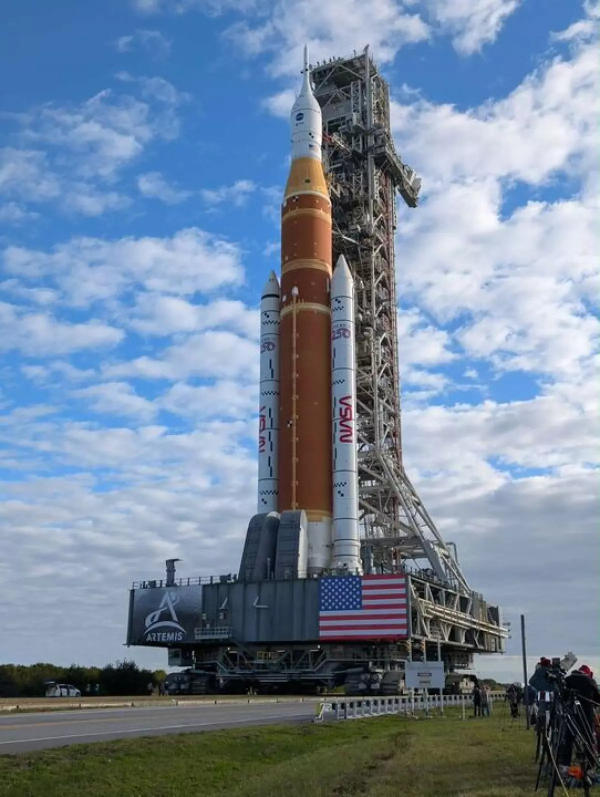
Artemis II; credit: Derek Demeter
NASA is ready for Artemis II, bringing a crew of four astronauts to fly around the moon. This 10-day mission includes the first woman and person of color.
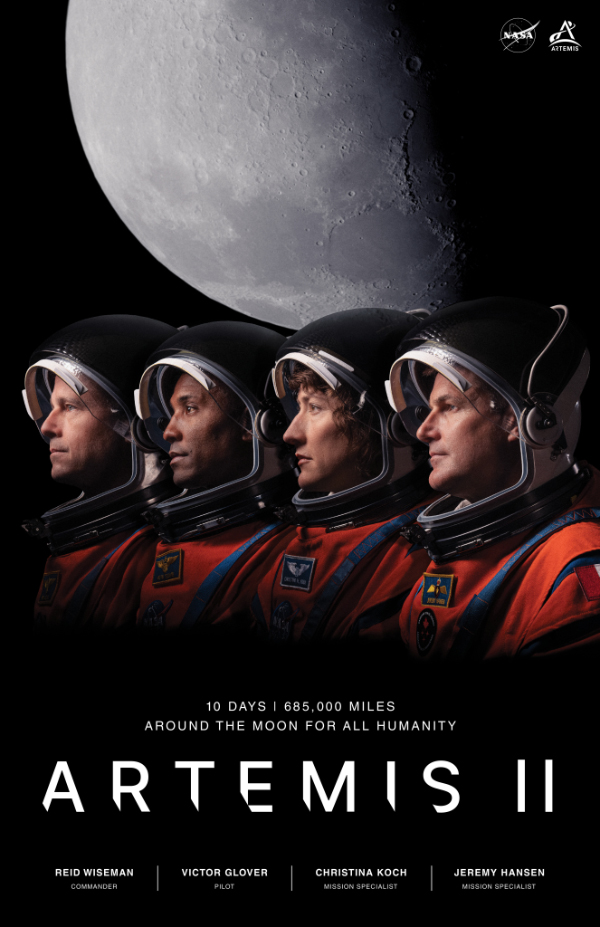
Who are these brave astronauts? Say hello to Reid Wiseman (Commander), Victor Glover (Pilot), Christina Koch (Mission Specialist), and Jeremy Hansen (Mission Specialist)!
The earliest possible launch window for Artemis II is February 6. This date depends on successfully completing final tests, especially the wet dress rehearsal (WDR), which is coming up soon. After this mission, the next big step is Artemis III, when astronauts will walk on the moon for the first time since 1972! The current schedule for launch is mid-2027. If successful, it will set the stage for a permanent moon base in the future.
Looking the other way in time, back in late 2022, Artemis I completed a successful mission. It was an uncrewed mission sending the reusable Orion spacecraft on a flyby of the moon.
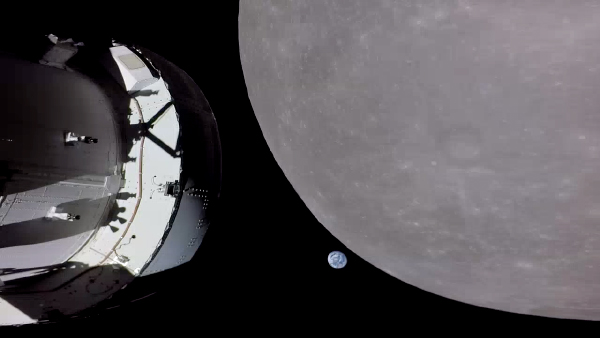
Earthset from Orion on Artemis I Mission; credit: NASA, 2022
A primary objective of the Artemis program is to combine NASA’s expertise with private companies to establish humanity’s long-term presence on the moon. For Artemis, NASA’s Human Landing System (HLS) program has contracted two companies to develop landers to bring people to the moon and back. Artemis III and IV will land via SpaceX’s Starship and Artemis V will use a Blue Origin lander.
Delays in the Artemis III program are primarily due to significant challenges with SpaceX's Starship lunar lander development, particularly its orbit refueling, heat shields, and life support systems.
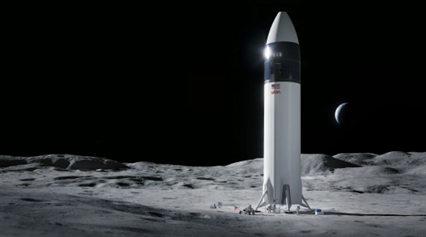
Artist rendition of SpaceX's Starship Lander; credit: SpaceX
Furthermore, Artemis works with other organizations that utilize semi-reusable vehicles. The Orion spacecraft—which holds the crew—is designed to be partially reusable and therefore more efficient.
Artemis II is close to launch, but space exploration is still a risky endeavor. All safety checks need to be followed rigorously. While it could launch this February, it could be delayed months. NASA Press Secretary Bethany Stevens posted on X on January 2 that “opportunities for Artemis II open February 6 and extend through the spring” (“through spring” meaning June 20).
Moon enthusiasts remain hopeful. In late December, Artemis II’s launch crew, control team, and ground crew conducted a series of training activities. On December 19, they conducted emergency rescue training, and the following day, they performed a countdown demo test with the launch vehicle in the Vehicle Assembly Building (VAB).

Artemis II Crew Countdown Test; credit: NASA/Joel Kowsky
Hopefully, we will see the crew orbiting the moon soon!
Food Constellations
A few years back, we created a Planetarium program simply called Constellations. We traveled the world and went back in time to see many imaginative star patterns. However, none of these were named after food. Then we thought, “What about constellations from nebulae and galaxies?” We found about 20 nourishing morsels and decided to share our top five!
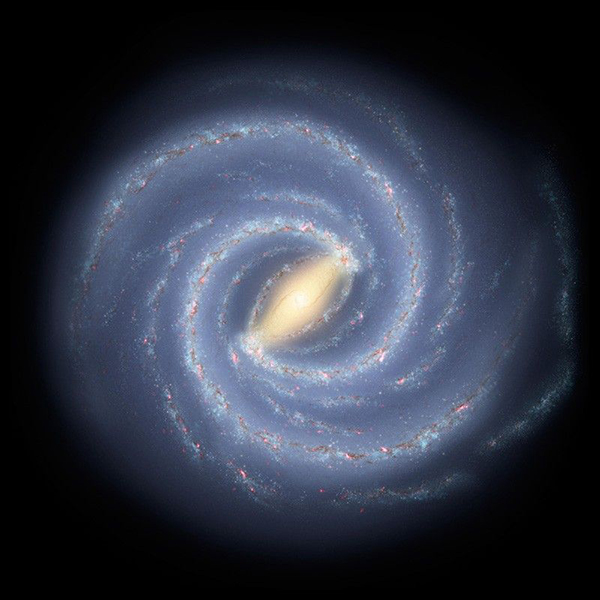
Credit: NASA/JPL-Caltech
1. Let's start with the most obvious, the Milky Way Galaxy. The name came from the Greeks who long ago saw this majestic light as milk spread across the sky. Today, we know this captivating light is from billions of stars in one of the spiral arms of our galaxy. We view this hazy band of light from inside the Orion arm (named for the Orion constellation because many bright stars and celestial features, like the Orion Nebula, are located within this local spiral arm). When looking towards the center of the galaxy in Sagittarius, we see many more stars. When we look straight away out of the galaxy in the constellation Auriga (near Taurus), we see a sparser starfield.
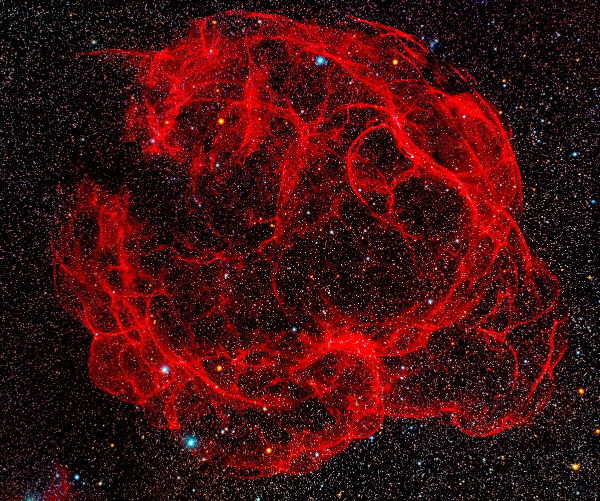
Spaghetti Nebula; credit: Miguel Claro NASA, ESA, J. Hester, and A. Loll (Arizona State University)
2. The Spaghetti Nebula—officially titled Simeis 147—is an enormous supernova remnant. It is the result of a massive star exploding about 40,000 years ago, back when humans first started migrating across the globe. At about 3,000 light-years from Earth, it sprawls across the sky with tangled filaments that look just like a plate of galactic pasta. This supernova remnant straddles the border between the constellations Taurus and Auriga. The nebula hides a spinning pulsar at the center of this cosmic cuisine.
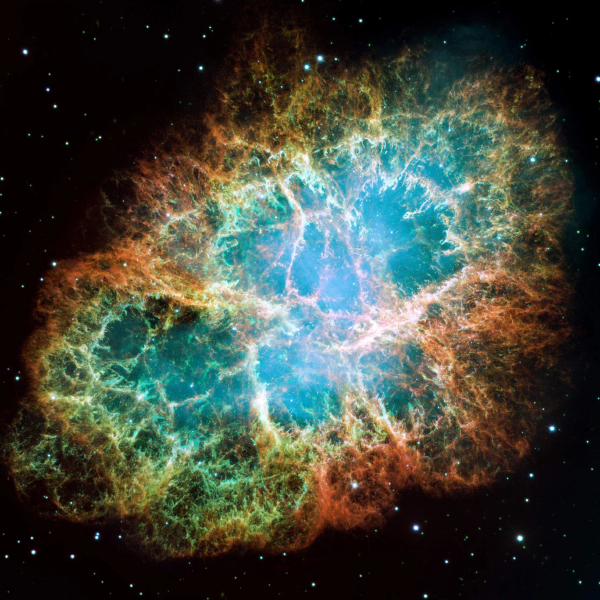
Crab Nebula; credit: NASA, ESA, J. Hester, and A. Loll (Arizona State University)
3. Next on our menu is another supernova remnant: the iconic Crab Nebula. Also called M1, this cosmic cloud sits closer than the Spaghetti Nebula at roughly 6,500 light-years away from Earth in the constellation Taurus. The crab-like remnant is expanding into space at a staggering speed of more than 600 miles per second. This stellar blast occurred in the year 1054 CE and was recorded by Chinese and Japanese observers as a "guest star." It may also have been documented by Indigenous people in the American Southwest via petroglyphs.
Crab Nebula Pulsar; credit: NASA & ESA
At the center lies another pulsar, a dense neutron star that spins 30 times per second, shooting out beams of radiation like a lighthouse.
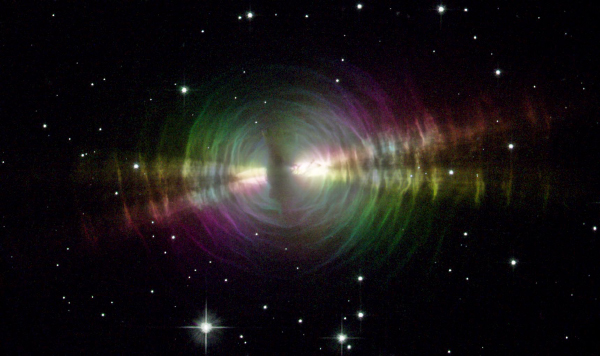
Egg Nebula; credit: NASA, W. Sparks (STScI), and R. Sahai (JPL)
4. The Egg Nebula is what happens when an old star dies and begins forming a gas cloud. The thick dust shells create a shining effect and are rapidly evolving. There is a central star that is hidden by dust. The star—hotter and more massive than our sun—lived its life faster. It is transforming itself into a white dwarf. That means it is no longer capable of nuclear fusion but still powerful enough to shine by residual heat. This radiation lights up the dust shells it has ejected, making them glow. The light becomes heavily polarized.
This nebula is located about 3,000 light-years away in the constellation Cygnus. Does it really look like an egg? What would your imagination call it?
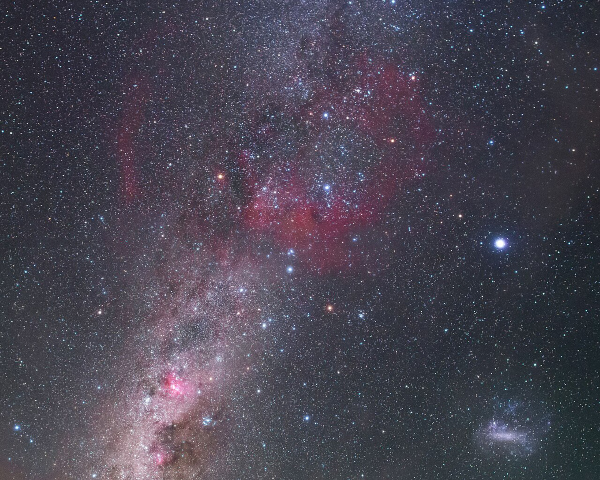
Gum Nebula; credit: ESO European Space Agency
5. Got a sweet tooth? Check out the Gum Nebula. I am not sure gum is considered food, but I guess you can chew on that. (Sorry!)
The Gum Nebula is huge, but faint, in the southern sky. Its nearest edge is only 450 light-years away. This glowing gas is called an emission nebula, mostly ionized hydrogen gas. The nebula sprawls more than 36 degrees in the sky, roughly 72 full moons across the constellations Vela and Puppis. It is an ancient enigma. Astronomers are not sure if it is from a supernova explosion about 1 million years ago or a molecular cloud shaped by multiple supernovae and stellar winds.
Except for the Milky Way, these other space constellations come from our powerful telescopes that unveil the beauty of our universe. We tend to name new discoveries after things that are familiar and important to us. It is only natural that some will resemble food!
Cosmic Hummingbirds
A talented ice skater can spin on the ice around five miles per second. A good washing machine rotates around 20 miles per second. The hummingbird flaps its wings about 80 times per second. Compare all that to a pulsar that can spin close to 1,000 times per second! What’s a pulsar? The remnant of a mammoth star that ended its life in a spectacular supernova.
Pulsar spin; credit: NASA's Goddard Space Flight Center/Conceptual Image Lab
Besides its furious spin, a pulsar has other bizarre properties. When a massive star explodes, not everything is blown off into space; an unbelievably small and dense core remains. A typical pulsar is only about 10-15 miles across. One tiny teaspoonful of this spinning dead star can weigh as much as a billion tons or 3,000 Empire State Buildings! The gravity here is so fierce that the electrons and protons are squeezed into neutrons. Pulsars are also known as neutron stars.

Jocelyn Bell, co-discoverer of the first pulsar in 1967
A pulsar is a younger, rotating neutron star that spins so rapidly, it sends its powerful magnetic field through space like a lighthouse beam. When the first one was discovered in 1967 by Jocelyn Bell, its signal was so regular that aliens were considered to be a possible source. This fairly serious notion led the discoverers to call the pulsar LGM-1. (LGM stands for “Little Green Men.”)
Space in 60 Seconds
Check out our February sky, including Valentine Nebula constellations!
Sky Sights
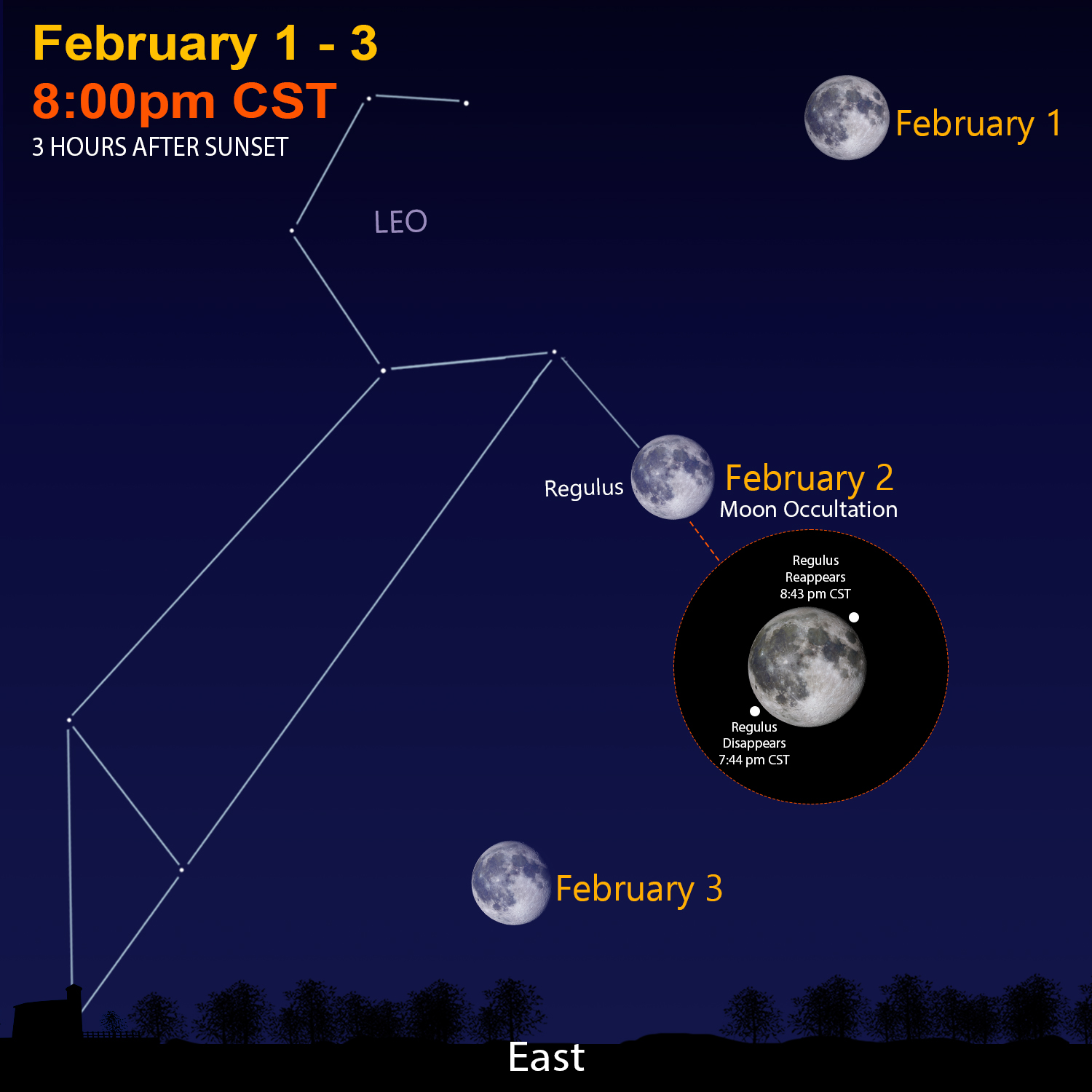
Watch the Moon eclipse, or occult, the bright star Regulus in Leo on February 2. The moon will be so bright, it will be difficult to see Regulus disappear (7:44 p.m. CST) and reappear (8:43 p.m. CST).
The full moon, sometimes called the Snow Moon, is on February 1.
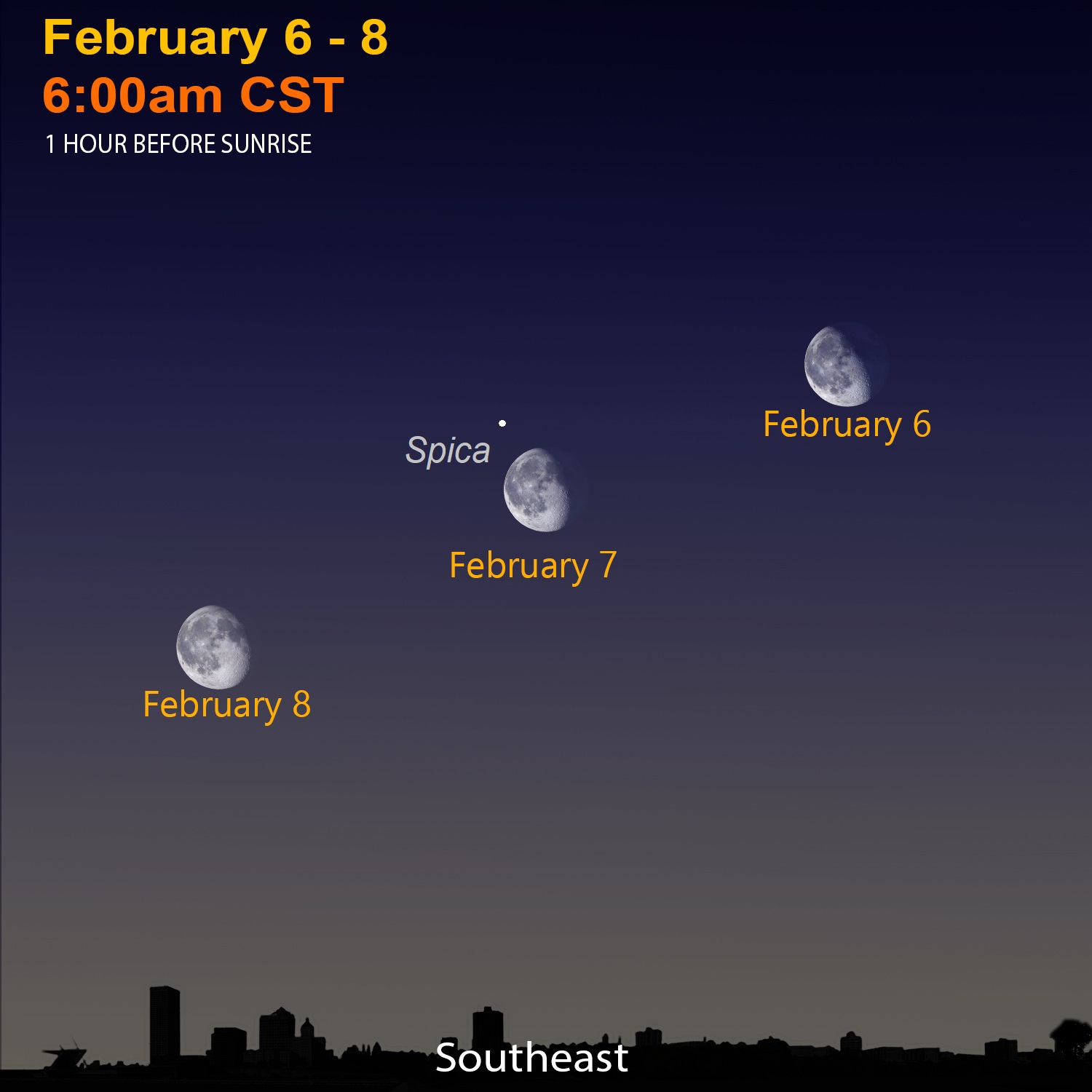
For early risers, observe the Moon passing the bright blue star Spica from February 6 to 8. Spica is a massive, hot, blue-white star about 250 light-years away. It is 12,000 times more luminous than the sun and eight times larger in diameter!
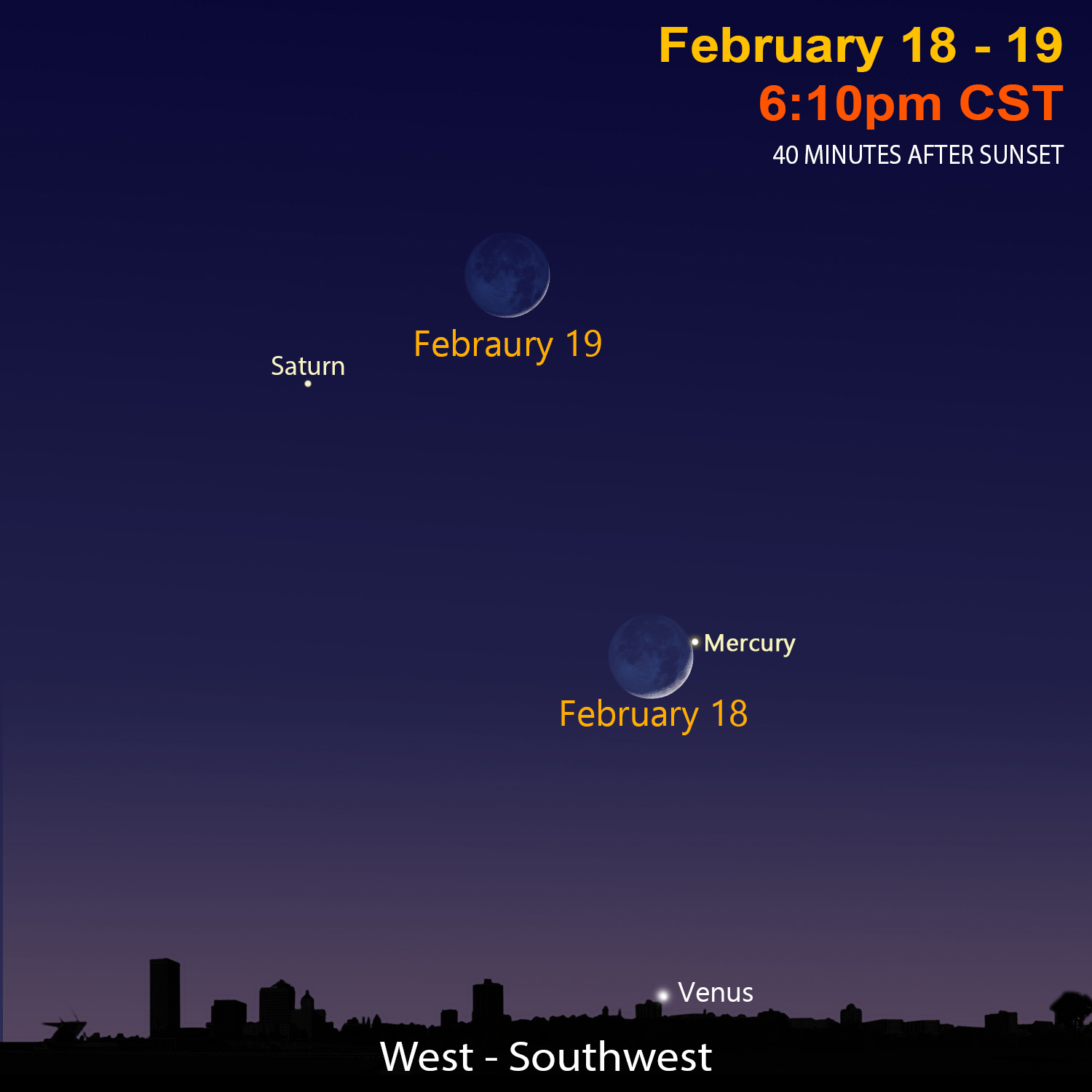
Venus and Mercury come into view mid-February. Use a skinny crescent Moon to find Mercury on February 18. Venus will be very low and tough to see in the sun’s twilight. Watch it get higher as the nights progress.
Saturn pairs up with the Moon on February 19.
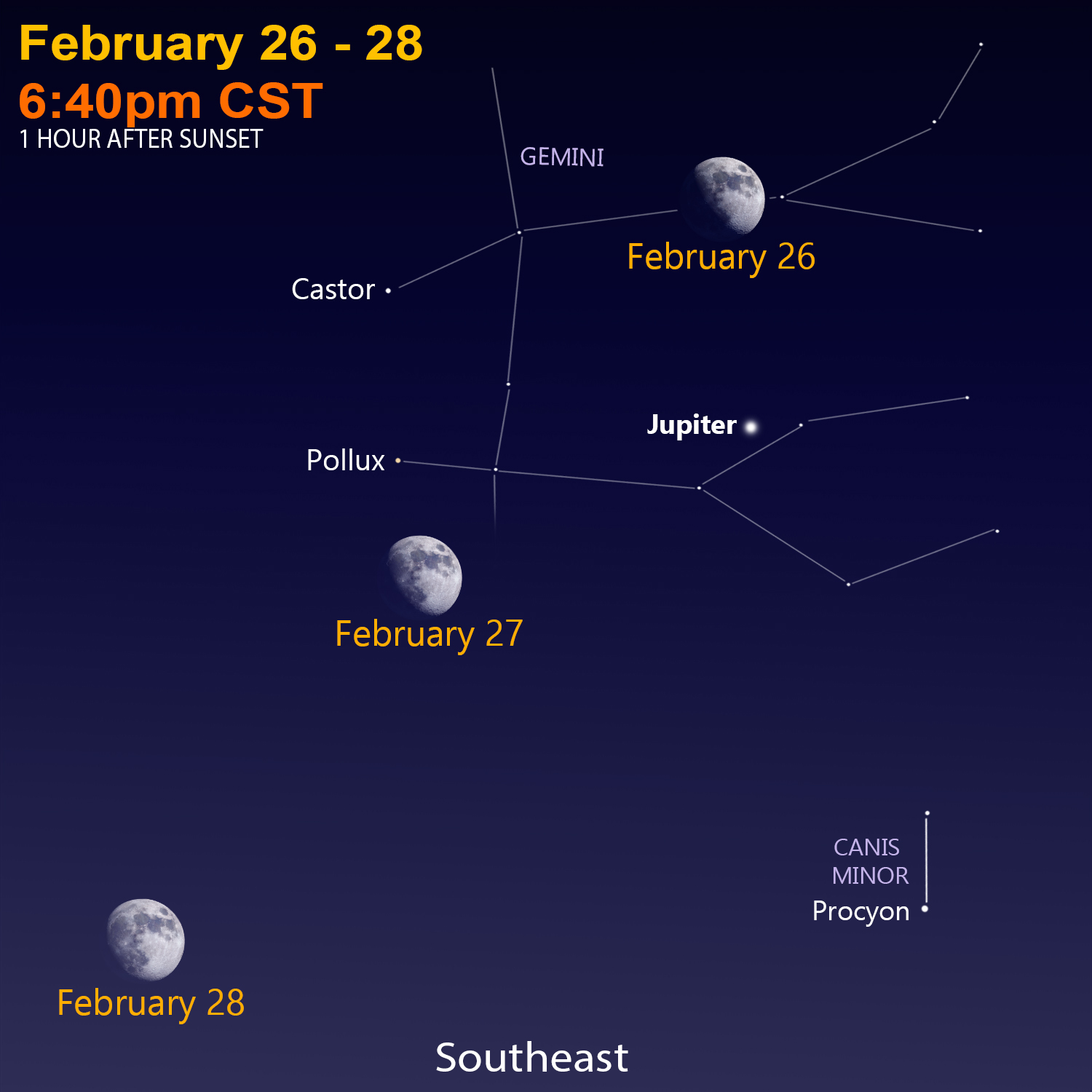
Jupiter and the Moon shine together in Gemini from February 26 to 28.
Mars is also not visible this month as the red planet hides behind the sun. It is moving to the morning sky from Earth’s perspective but will not become visible until late April.
February Star Map
Sign Up
Receive this newsletter via email!
Subscribe
See the Universe through a telescope
Join one of the Milwaukee-area astronomy clubs and spot craters on the Moon, the rings of Saturn, the moons of Jupiter, and much more.
Follow Bob on social media
Twitter: @MPMPlanetarium
Facebook: Daniel M. Soref Planetarium