

Planetarium Newsletter - May 2026
Cosmic Curiosities
“I am a moonbeam, free to go whenever I choose.”
- Marina Tsvetaeva, Russian Poet
Moonbeams
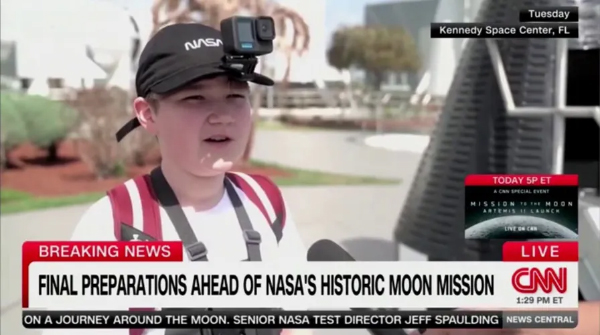
Credit: CNN
KIDS BEAMING
Before the launch, a CNN reporter asked a young space enthusiast, "Why do you want to be here? Why do you love space? Why do you love being a part of history?” The focused moon expert, Hilt Boling, was blunt with his answer.
“We are going back to the frickin’ moon! That’s why. We’re sending a woman, a person of color, and a Canadian to the moon. And we’re sending a manned spacecraft farther than we sent a spacecraft before.”
Well said, young Mr. Boling. The video quickly went viral, gaining millions of views on social media platforms and was shared by various media outlets.
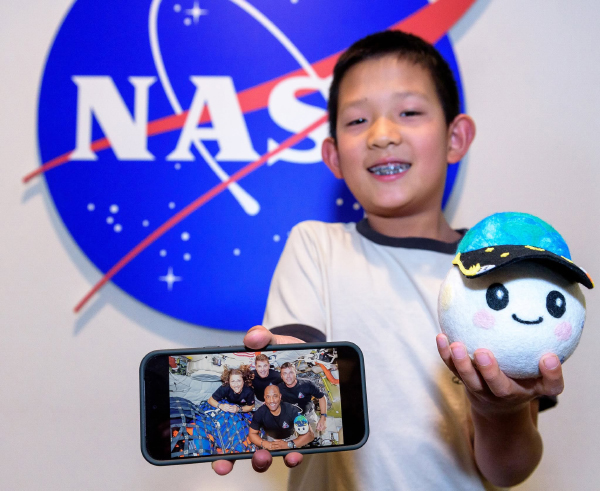
Credit: NASA
Another story revolves around 8-year-old Lucas Ye from Mountain View, California. The young moon wiz designed a plush “Rise” mascot that actually flew aboard the Artemis II spacecraft. Lucas called the experience “really cool” and said it made his ideas feel big and possible.
ASTRONAUTS BEAMING
Astronaut Reid Wiseman captured a truly remarkable moment when he recorded a video of the Earth setting behind the moon using his iPhone. Looking out a window on NASA's Orion spacecraft, it took Wisemen about seven seconds to focus, but when he did, you hear the impressed astronauts voice their “wows.” Another astronaut says very slowly, “Dude... No... Way.” The inflection of their voices tells me how amazed and surprised they were to witness such a breathtaking sight.
What makes this footage so compelling is not just the view itself, but the simplicity of the tool used to capture it. In an environment filled with advanced scientific instruments, a handheld device most people carry in their pockets was enough to document something so vast and awe-inspiring.
Credit: Reid Wisemen, NASA
The video shows a small Earth, but you can still see its swirling white clouds and deep blue oceans. Being so close to the moon, you notice its cratered face. This perspective is rare. We usually see a large Earth and small moon.
Historically, images of Earth and the moon together have carried profound meaning. During the Apollo 8 mission, astronauts captured the iconic Earthrise photograph, showing Earth rising above the lunar horizon—an image that reshaped how humanity views its home.
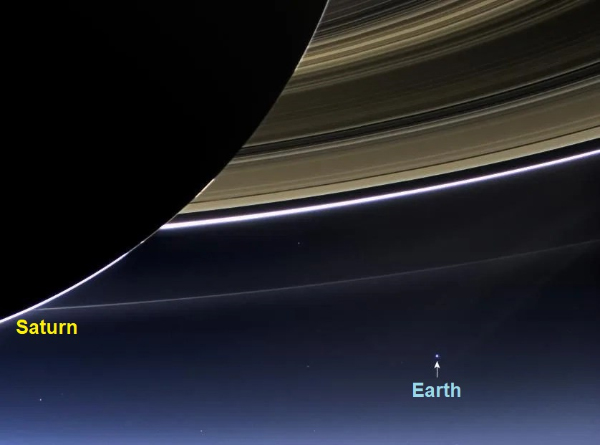
Credit: NASA
Later, the Voyager 1 mission produced the famous Pale Blue Dot, emphasizing Earth’s tiny place in the cosmos. Wiseman’s video continues this tradition, blending modern technology with a timeless sense of wonder.
FUTURE BEAMING
All the excitement for the Artemis moon mission is great to see. Best wishes to NASA and the future astronauts who are scheduled to walk on the moon in 2028!
JWST Update
The James Webb Space Telescope (JWST) continues to dazzle. Here is a quick tour of three images taken in the last six months.
VERY DISTANT VIRGIL GALAXY
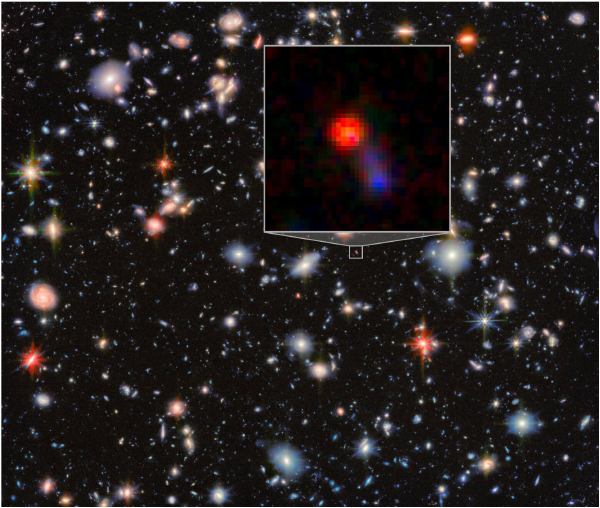
Credit: ESA/Webb, NASA & CSA, G. Östlin, P. G. Perez-Gonzalez, J. Melinder, the JADES Collaboration, M. Zamani (ESA/Webb)
Astronomers pointed the telescope to the constellation Carina and took a long exposure picture to capture a very distant—and therefore young—galaxy. The red galaxy in the shown photo reveals the universe when it was only 800 million years old. It is 13.8 billion years old now. This means you are looking back in time 13 billion years. Scientists have determined the galaxy already harbors a supermassive black hole, even though the universe is very young.
This discovery is a challenge in figuring out how black holes formed so quickly after the Big Bang. The teams of discoverers dubbed this galaxy “Virgil” after the Roman poet who guided Dante in The Divine Comedy.
SATURN IN INFRARED LIGHT
Credit: NASA, ESA, CSA, STScI; Image Processing: Joseph DePasquale (STScI)
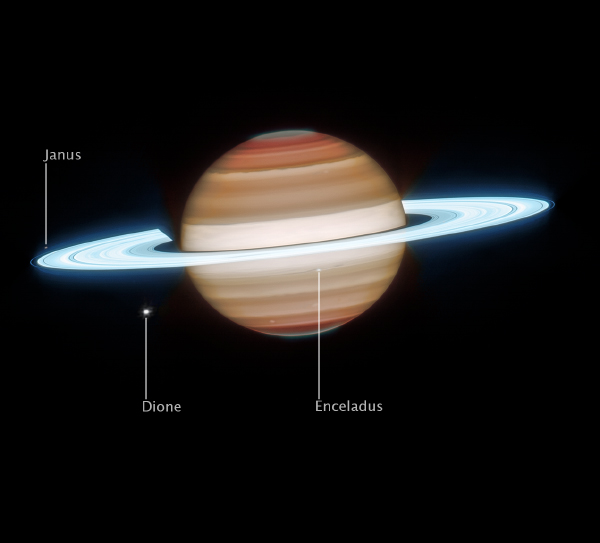
Saturn’s stunning rings never fail to capture our eyes. This infrared image, released in March 2026, captures the icy rings in an eerie, brilliant glow. Because the rings have lots of water ice, they reflect infrared light far more efficiently than the planet's methane-heavy atmosphere. JWST worked with the Hubble Space Telescope on this image.
Hubble just celebrated its 36th birthday in space on April 20.
SPIRAL GALAXY NGC 5134
Credit: ESA/Webb, NASA & CSA, A. Leroy
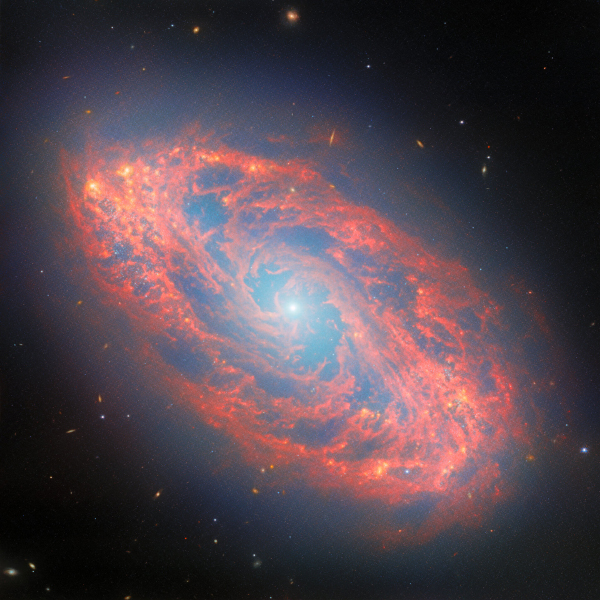
JWST took a truly spectacular view of the spiral galaxy NGC 5134 that showcases reddish dust clouds and newborn stars. The image reminds us of the life cycles of the stars. Stars are born and live a very long life. They shine for millions, billions, and even trillions of years!
Located about 65 million light-years away in the constellation Virgo, this is relatively close as galaxies go. It means that JWST can resolve remarkable details in the tightly wound spiral arms of the galaxy.
Wisconsin Fireball!
Credit: American Meteor Society
A very bright meteor, likely a fireball, was observed and caught on camera on April 10, 2026, in Afton, Wisconsin, just south of Janesville. Reports indicate it was traveling south in the sky.
If you ever see a meteor that dazzles you, please report it to the American Meteor Society (AMS). You can also use the website to see if anyone else saw the meteor you did. Some people upload their videos, like the one shown here. Today, with dashcams and security cameras, many people capture such bright meteor events without seeing them directly.
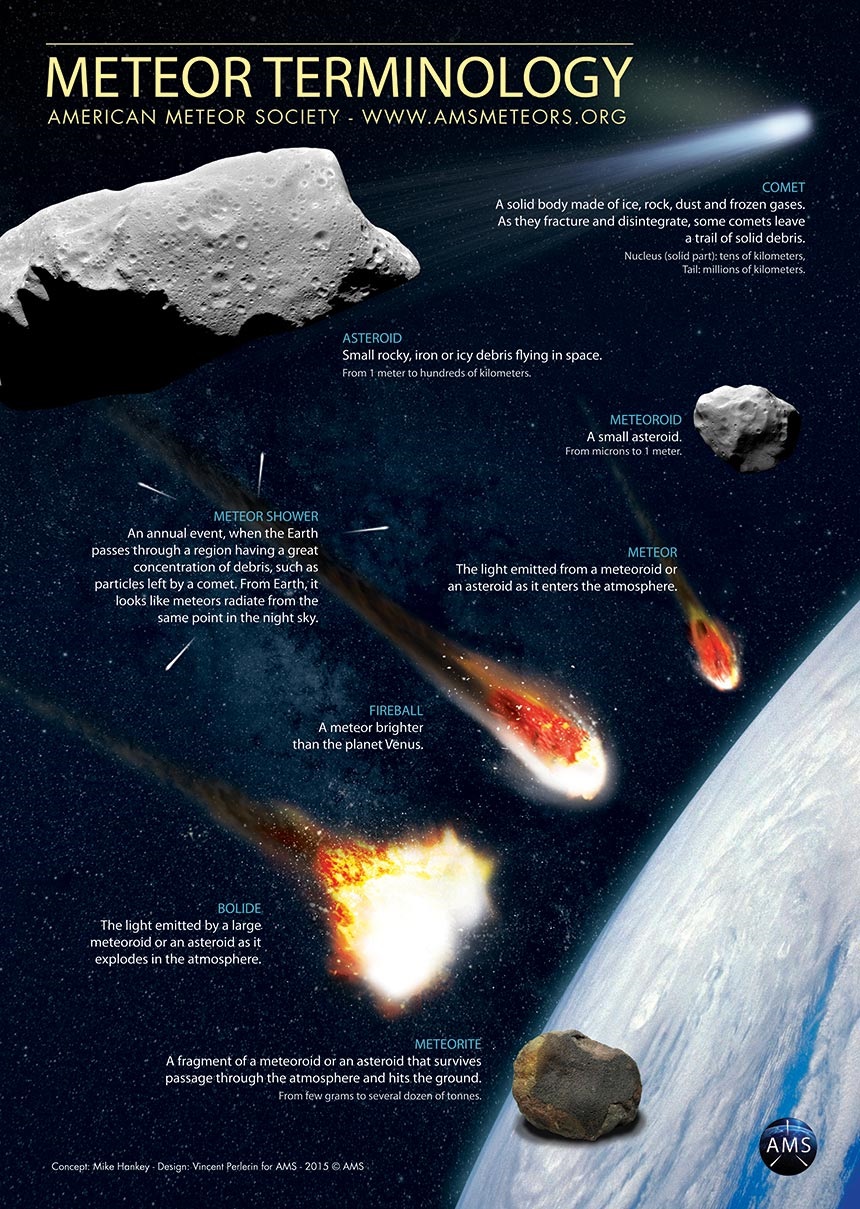
A fireball is a “shooting star” that is brighter than the planet Venus. That is insanely bright! For more meteor terminology, see the picture chart.
Space in 60 Seconds
Find a blue moon in the May sky and relive the fabulous Artemis moon mission!
Sky Sights
BLUE MOON THIS MAY
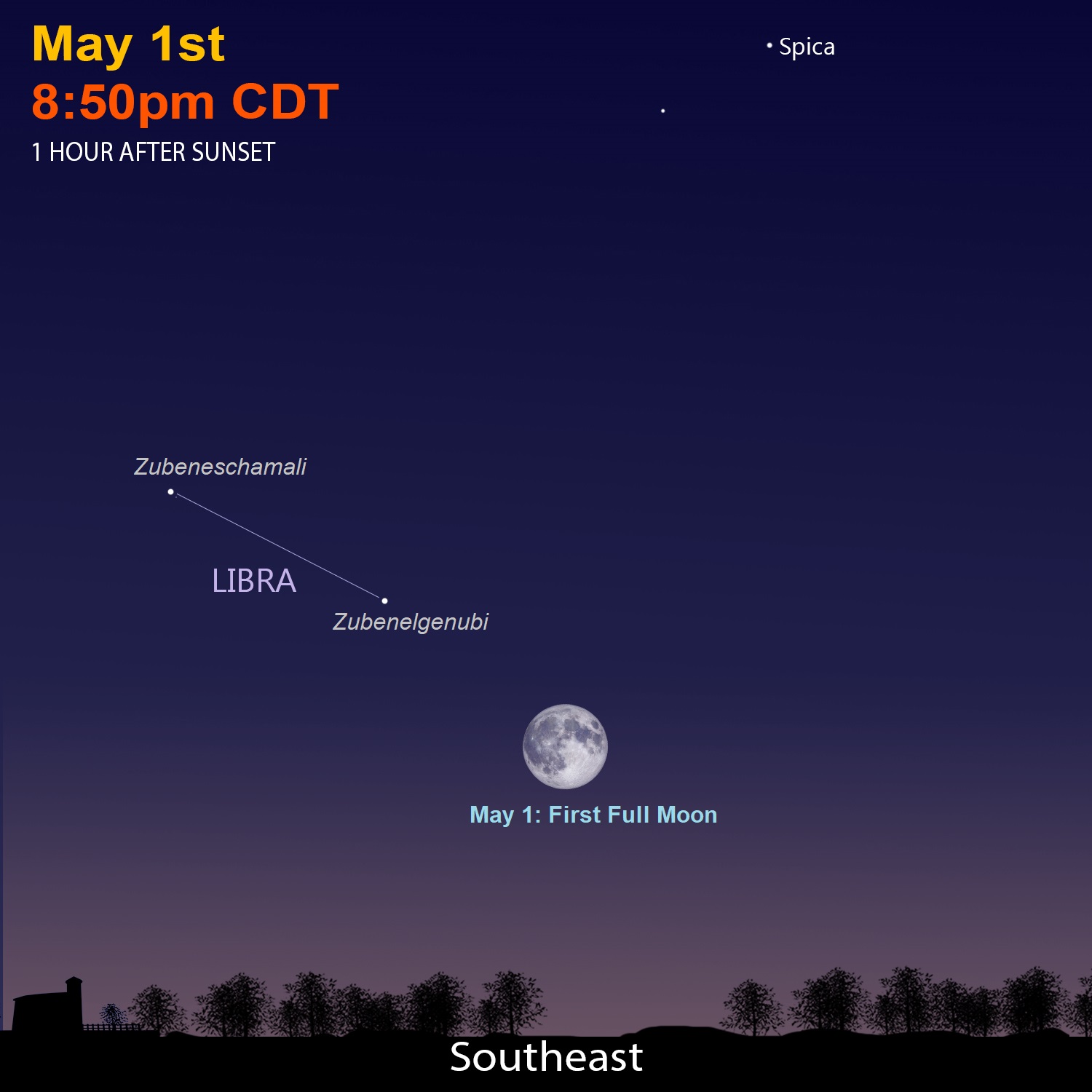
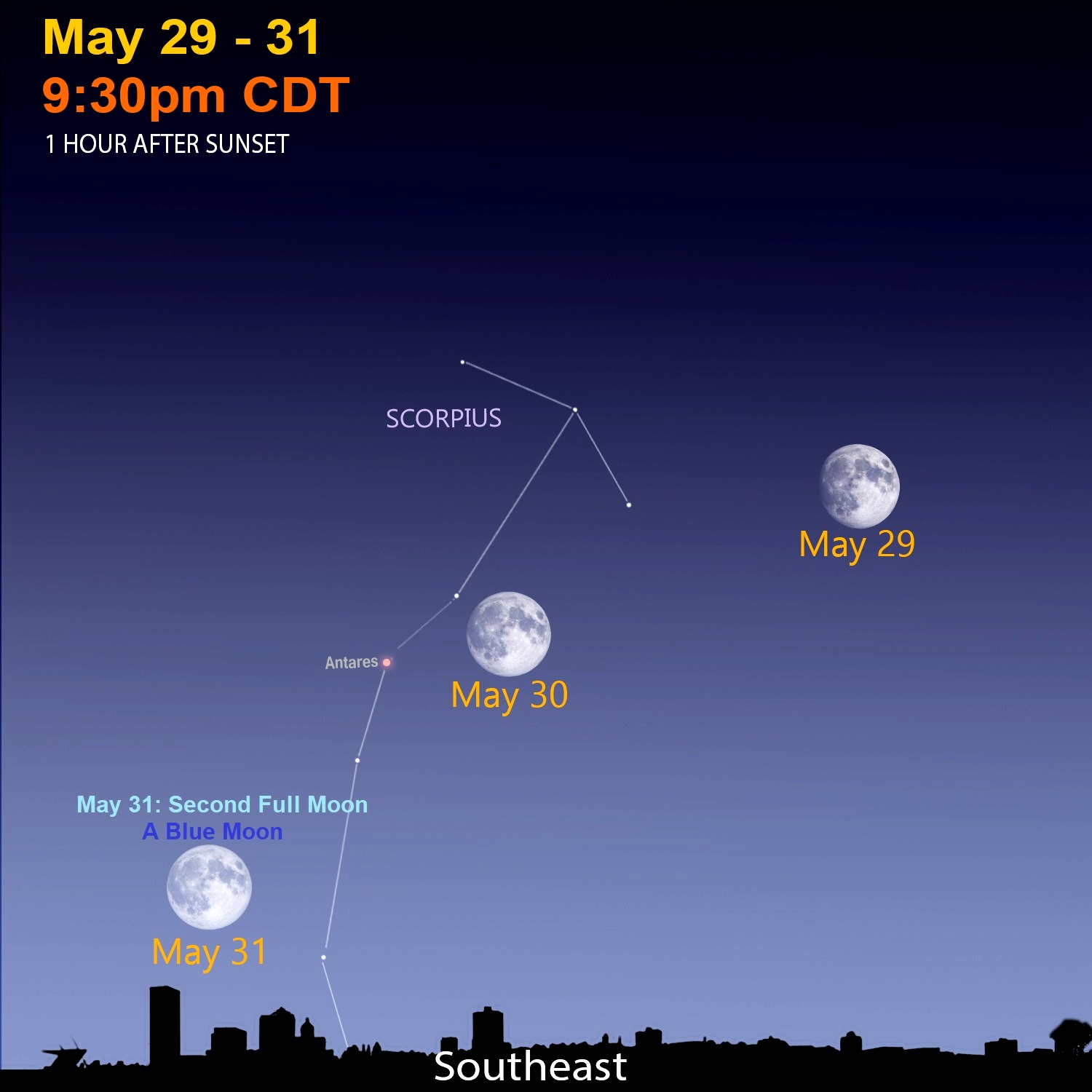
We have two full Moons this month—on May 1 and May 31. The second one is called a Blue Moon, though it does not turn blue.
Our “month” comes from the moon. They used to be called “moonths.” The time between full moons is 29.53 days. We know there are 365.25 days in a year. So, this means we have an “extra” full moon roughly every two to three years (or seven times every 19 years). This year, we have an additional 13th full moon, and it lands on May 31.
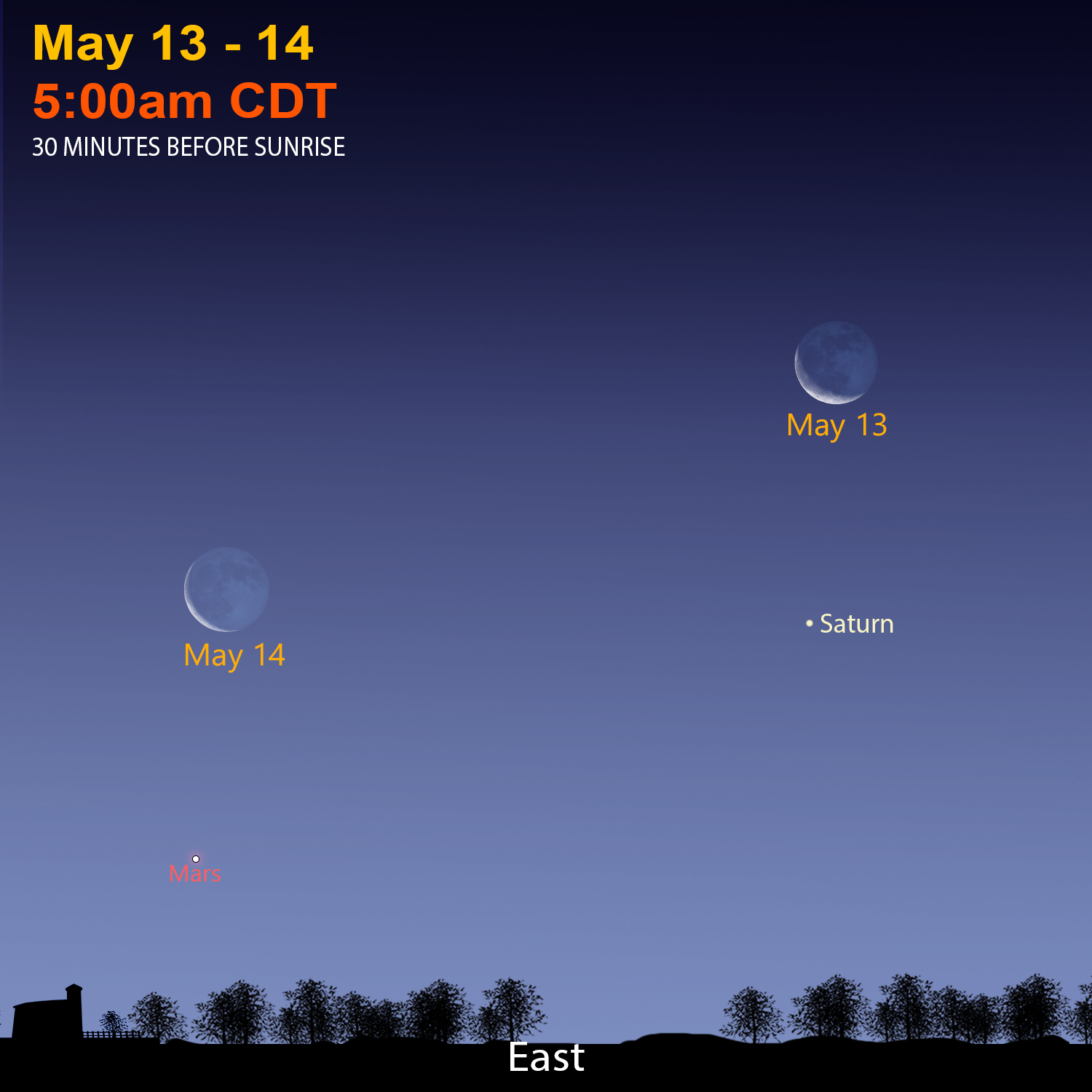
Mars and Saturn are back! However, these planets are not easy to spot in the morning sky. Plus, you will have to get up early. Sunrise in mid-May is 5:30 a.m. CDT.
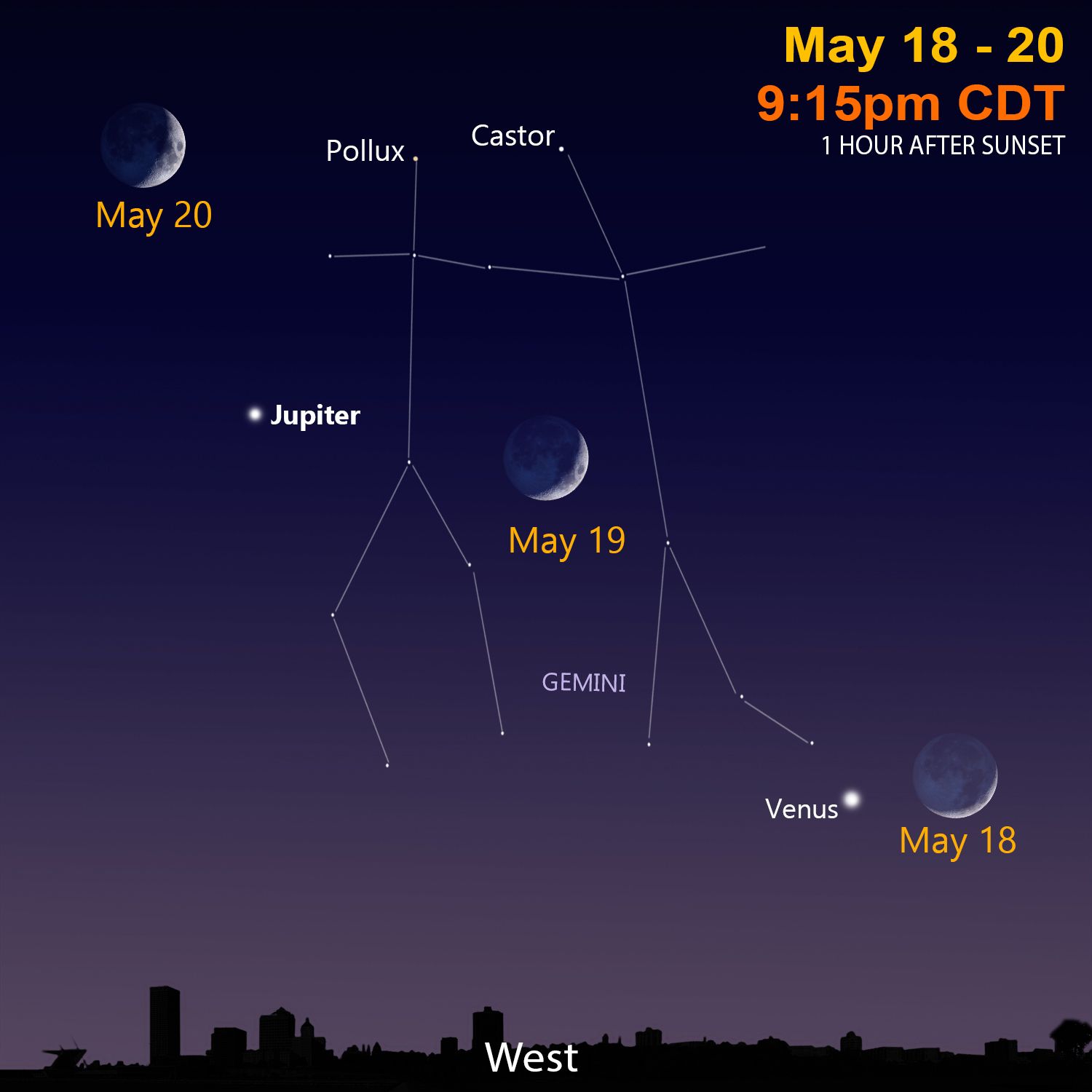
Venus and Jupiter are getting closer together. Mark your calendar for the nights of June 8 and 9, when they will line up looking like they are close friends. A crescent Moon can be seen near the two planets from May 18 to 20.
May Star Map
Sign Up
Receive this newsletter via email!
Subscribe
See the Universe through a telescope
Join one of the Milwaukee-area astronomy clubs and spot craters on the Moon, the rings of Saturn, the moons of Jupiter, and much more.
Follow Bob on social media
Twitter: @MPMPlanetarium
Facebook: Daniel M. Soref Planetarium