

Planetarium Newsletter - September 2026
Cosmic Curiosities
What, then, is time? If no one asks me, I know what it is. If I wish to explain it to him who asks, I do not know.
- Saint Augustine, 4th Century CE
The Strangeness of Time
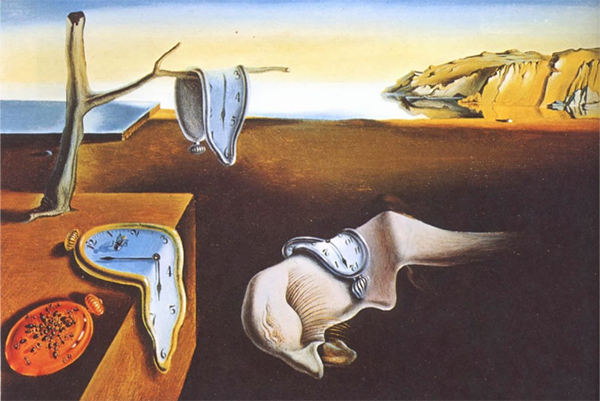
Credit: Salvador Dalí, The Persistence of Memory, 1931 @ MoMA in New York
Time is strange. If we slow down and ponder time, we find perplexing qualities!
Firstly, time never stops. It only goes one way—forward. And yet, we constantly take our minds back in time. Conversely, we like to jump ahead to the future to see what awaits us. Ironically, with all the attention we pay to time, it is still difficult to be present. The playwright Eugene O'Neill called present time a "strange interlude."
We measure time; we created time periods. Some are based on nature, like our day, coming from the Earth's rotation, or the month, born from the cycle of the moon's phases. Finally, we have the year, one Earth journey around the sun.
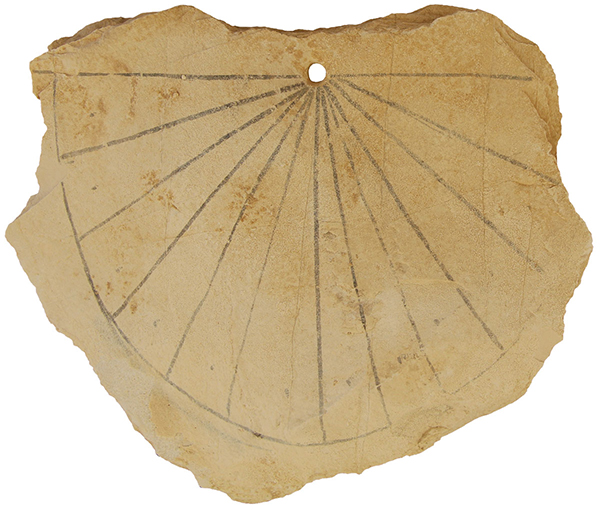
Ancient Egyptian Sundial; credit: University of Basel, Egyptology
Our hours, minutes, and seconds come from ancient civilizations. The Egyptians divided day and night into 12 parts each. The world's oldest known sundial came from Egypt's Valley of the Kings in 1500 BCE. It was used to measure work hours. The minutes and seconds grew out of the Babylonian base-60 numerical system for tracking the sky and geometry. The 360-degree circle was found to be equally divisible by many whole numbers and easy to use to track time. Then, Greek astronomers like Eratosthenes and Hipparchus took the Egyptian 24 hours and divided them into the 60 minutes and 60 seconds we use today.
Today's modern science makes time both more precise and more mysterious. We no longer define the second by Earth's rotation, which is slowing down as the sun and moon's gravity tugs on our planet. Today, the second is based on the behavior of the cesium-133 atom: Exactly 9,192,631,770 cycles of a particular atomic transition constitute one second. Imagine measuring that!
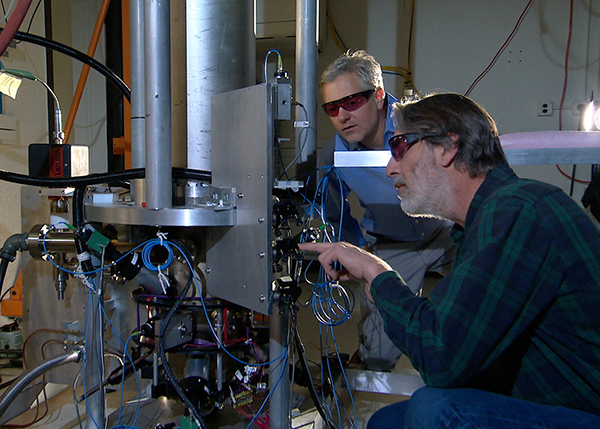
Physicists Steve Jefferts and Tom Heavner with Cesium Atomic Clock; credit: NIST (National Institute of Standards & Technology)
It's peculiar to know that all these time periods do not really measure time itself. They measure intervals between events.
So, why does time only move forward? (Sure, in many science fiction movies, they often move back and forth in time!) The apparent direction of time is associated with the arrow of time, particularly the second law of thermodynamics, or entropy. This means that everything in the universe is running down. All the matter and energy in the universe started with the Big Bang, very hot 13.8 billion years ago, and since then, everything has been cooling down. Heat flows from hot objects to colder ones. Time's forward march may arise from the behavior of matter rather than from a cosmic clock ticking inexorably forward.
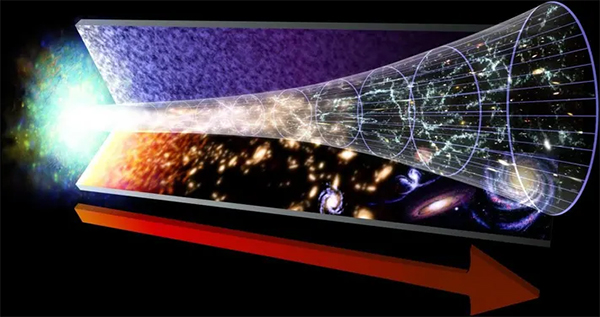
The History of the Universe and the arrow of time; credit: NASA / GSFC.
Black holes cause time to get extra weird! From the viewpoint of a distant observer, an object falling toward a black hole's event horizon appears to slow dramatically. Its light becomes increasingly redshifted and faint. The object appears almost frozen in time. In fact, black holes used to be called frozen stars! But time does not literally stop for the falling object nearing the black hole; its own clock continues normally as it crosses the horizon. The apparent freezing is a consequence of Einstein's theory of relativity and the way distant observers receive signals.
We cannot see time, nor can we step outside it. Somehow, though, our curiosity and discovery have constructed a history of a fascinating universe stretching back billions of years through time.
Harvest Moons
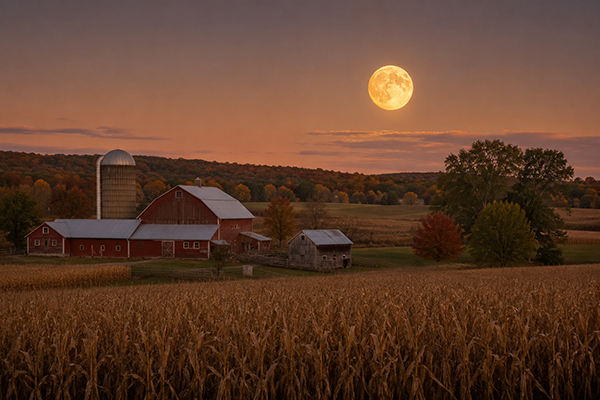
Autumn is coming soon! School starts, days grow shorter and cooler, and it's time for the Harvest Moons.
Technically, the Harvest Moon (singular) is the full moon nearest the first day of fall. Since autumn is the time to bring in crops, this full moon became the Harvest Moon. This year, the moon grows whole on September 26. Fall begins on September 22.
What is the deal with more than one Harvest Moon? On average, the moon rises almost an hour later each night. But near the autumnal equinox, the moon rises only 25 to 30 minutes later each night. With the quicker moonrise after sunset, farmers had extra moonlight to help them bring in their harvest. By the time twilight ended, the moon would rise, making it seem like another full moon. Thus, the Harvest Moons!
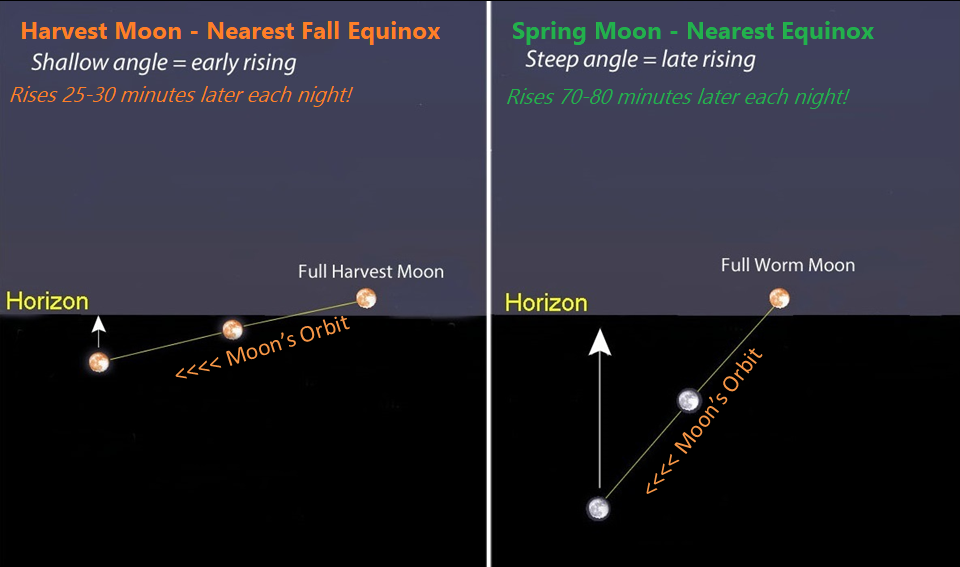
This effect is caused by the moon's orbit and its shallow angle to the eastern horizon this time of year. In spring, the effect is just the opposite, with a long delay between moonrises.
So, step outside and enjoy the extra moonlight that a changing angle can cause.
Shine on, Harvest Moons!
Empty Solar System
Space pictures often look crowded, but space itself is mostly empty. It's a matter of the great distance between celestial objects and their comparative small size.
Credit: NASA
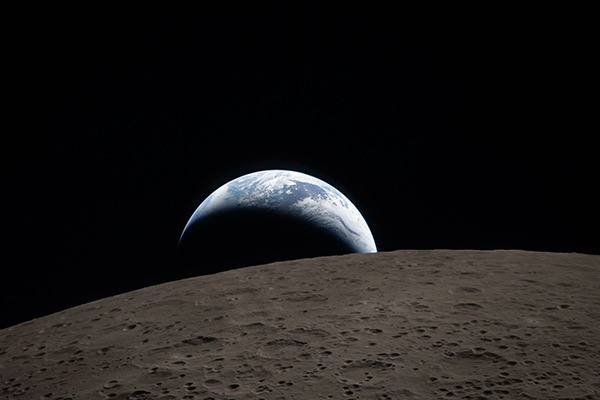
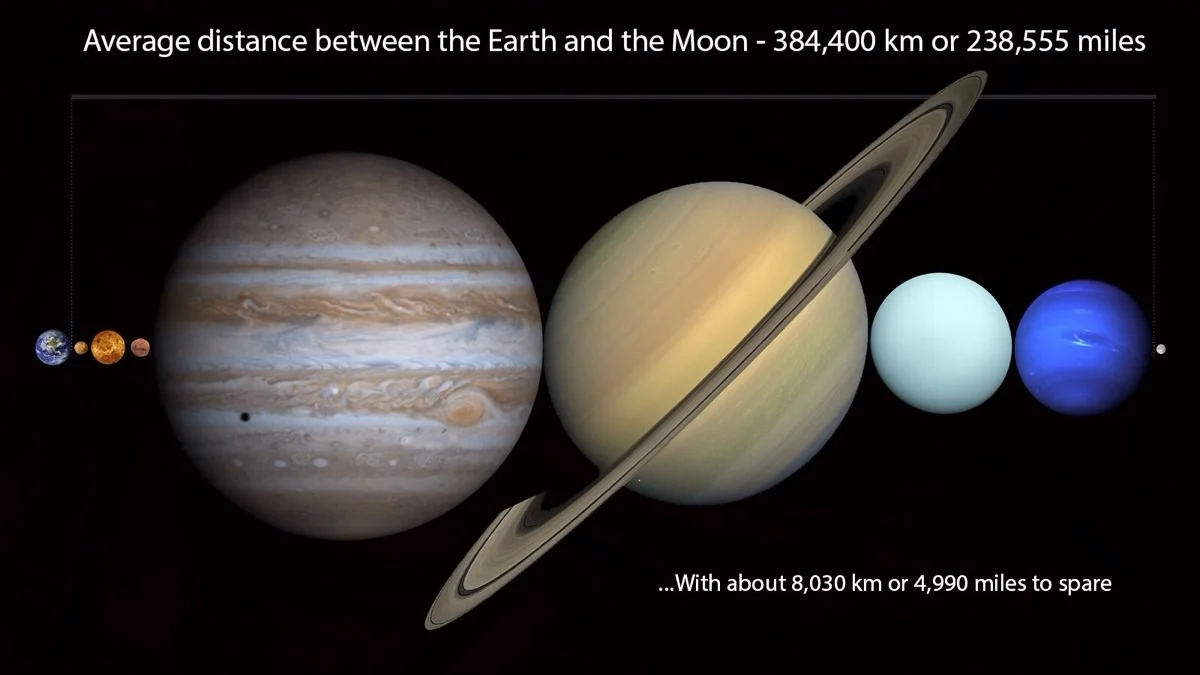
The Earth and moon are tiny compared to the miles between them, though our planet can look incredibly large from the moon, as recently witnessed by the Artemis II astronauts. The moon, too, often looks big in our skies. The distance from Earth to the moon—240,00 miles on average—is small when measuring it against the larger gaps between planets. In fact, the empty space between the Earth and moon is only 0.00006% of the vast distance from the sun to Pluto—almost 4 billion miles!
Therefore, if we crunch the numbers, the other seven planets of the Solar System (Mercury, Venus, Mars, Jupiter, Saturn, Uranus, and Neptune, and even Pluto) could fit into the space between Earth and the moon.
Credit: NASA/JPL-Caltech
Thank goodness the planets are not that close to us. All their gravity would create havoc here on tiny Earth and our little moon!
Space in 60 Seconds
Get ready for extra moonlight from the Harvest Moons this September.
Sky Sights
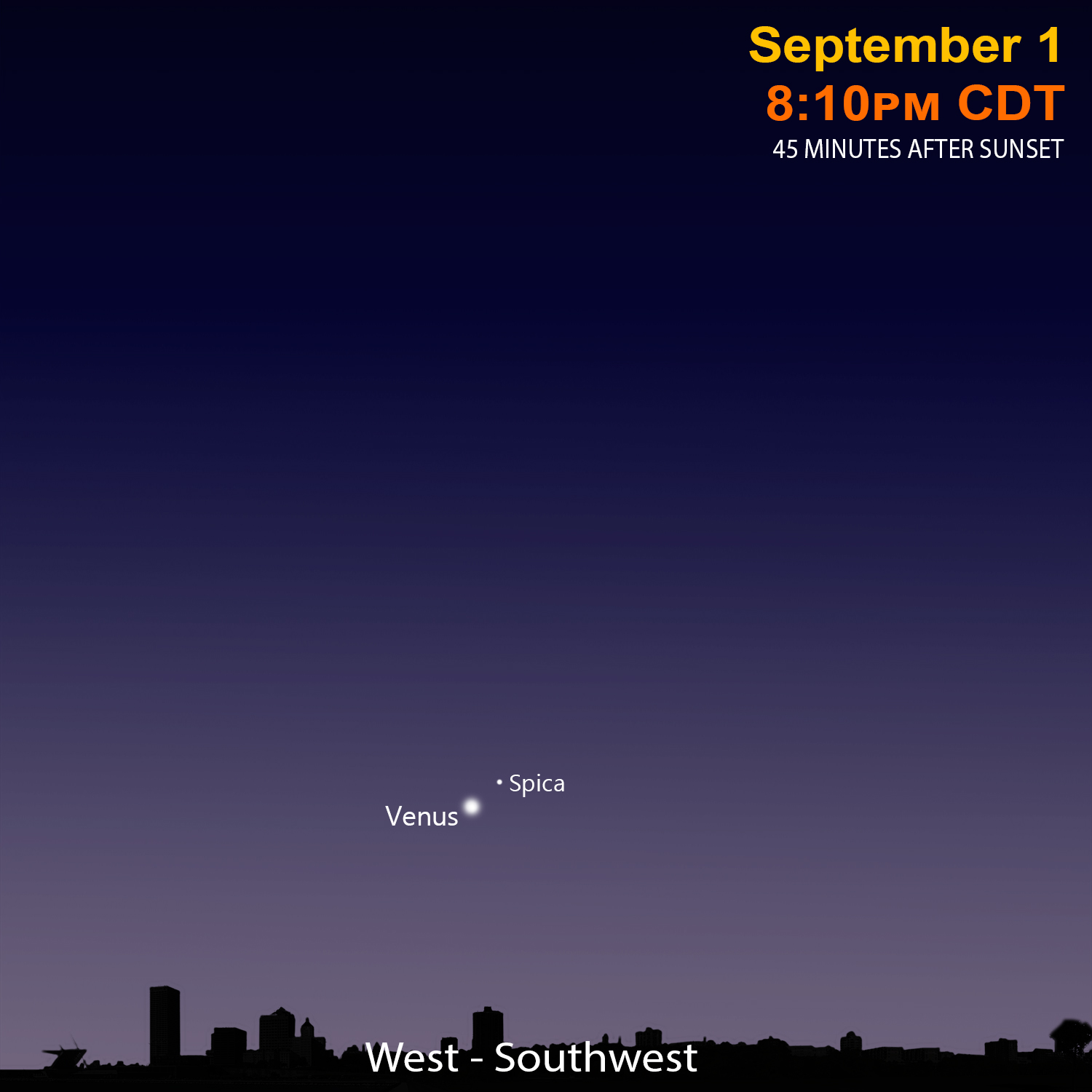
Venus shines low in the west after sunset and near the bright star Spica. The hottest planet gets lower each night as it aligns closer to the sun.
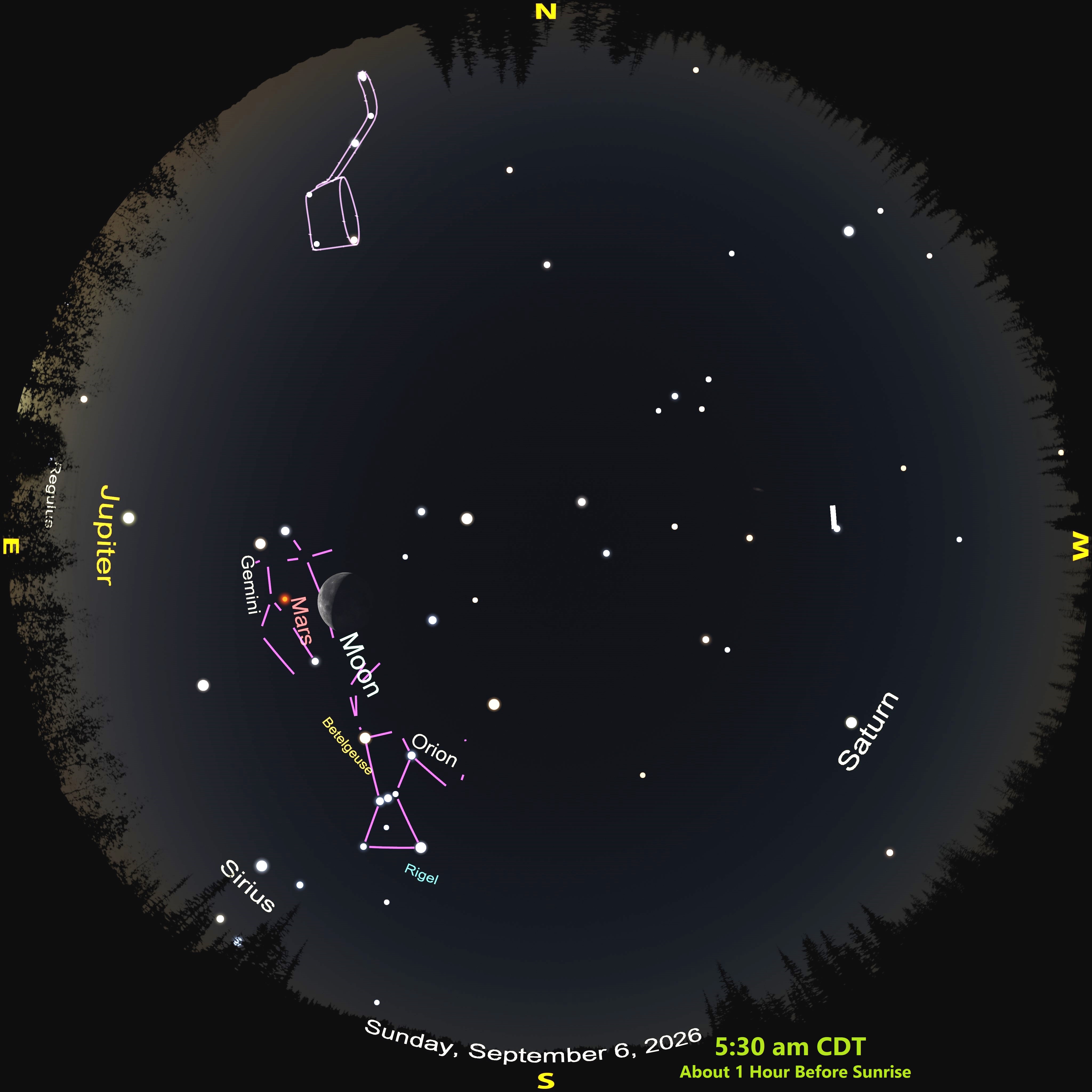
On Labor Day weekend, get up early to see a spectacular morning sky with all the bright stars of Orion, Gemini, and the Big Dipper. Don't forget to spot the night's brightest star, Sirius, below Orion's belt. The Moon pairs up with Mars on September 6 in Gemini.
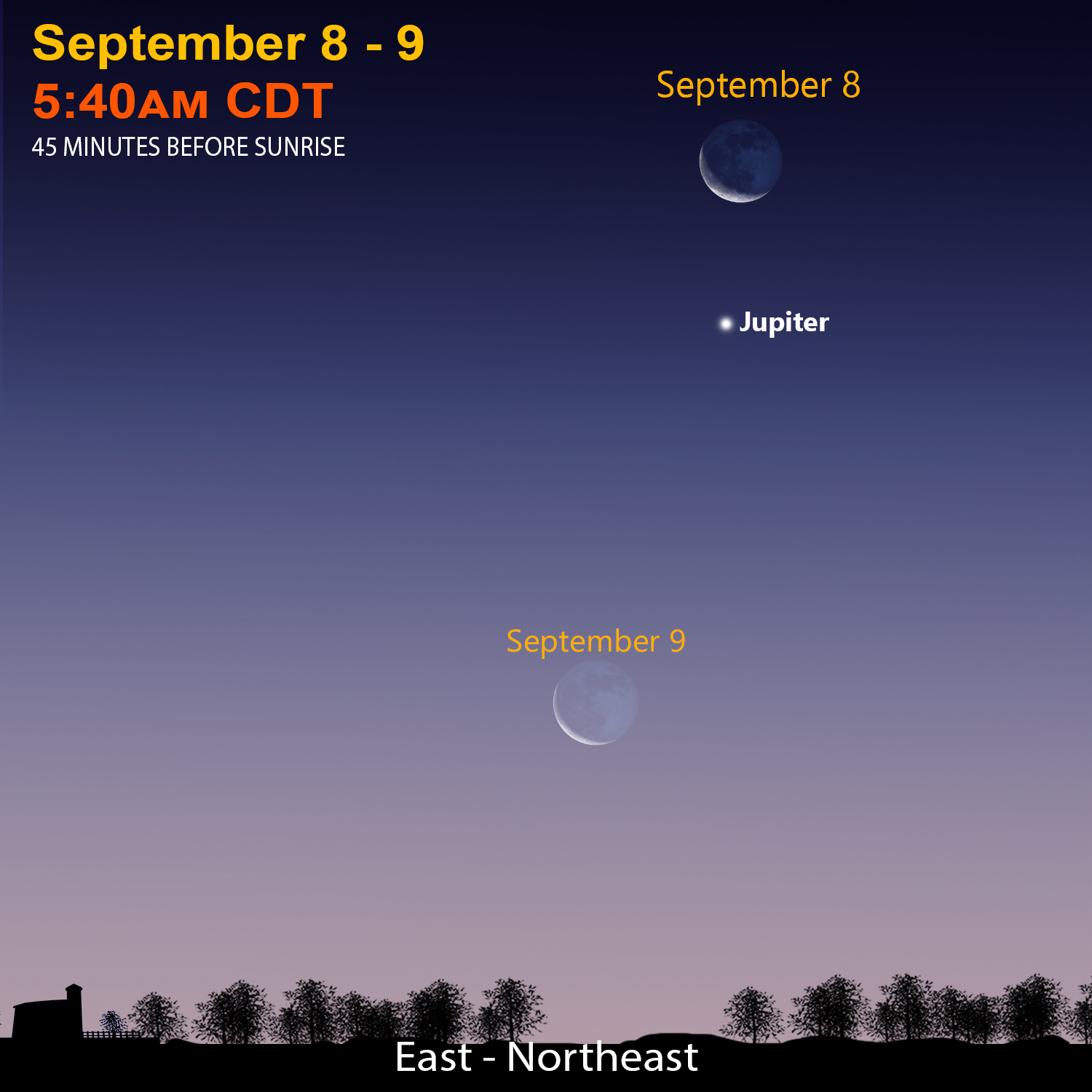
On the mornings of September 8 and 9, very low in the ENE, a waning crescent Moon can be seen with bright Jupiter.
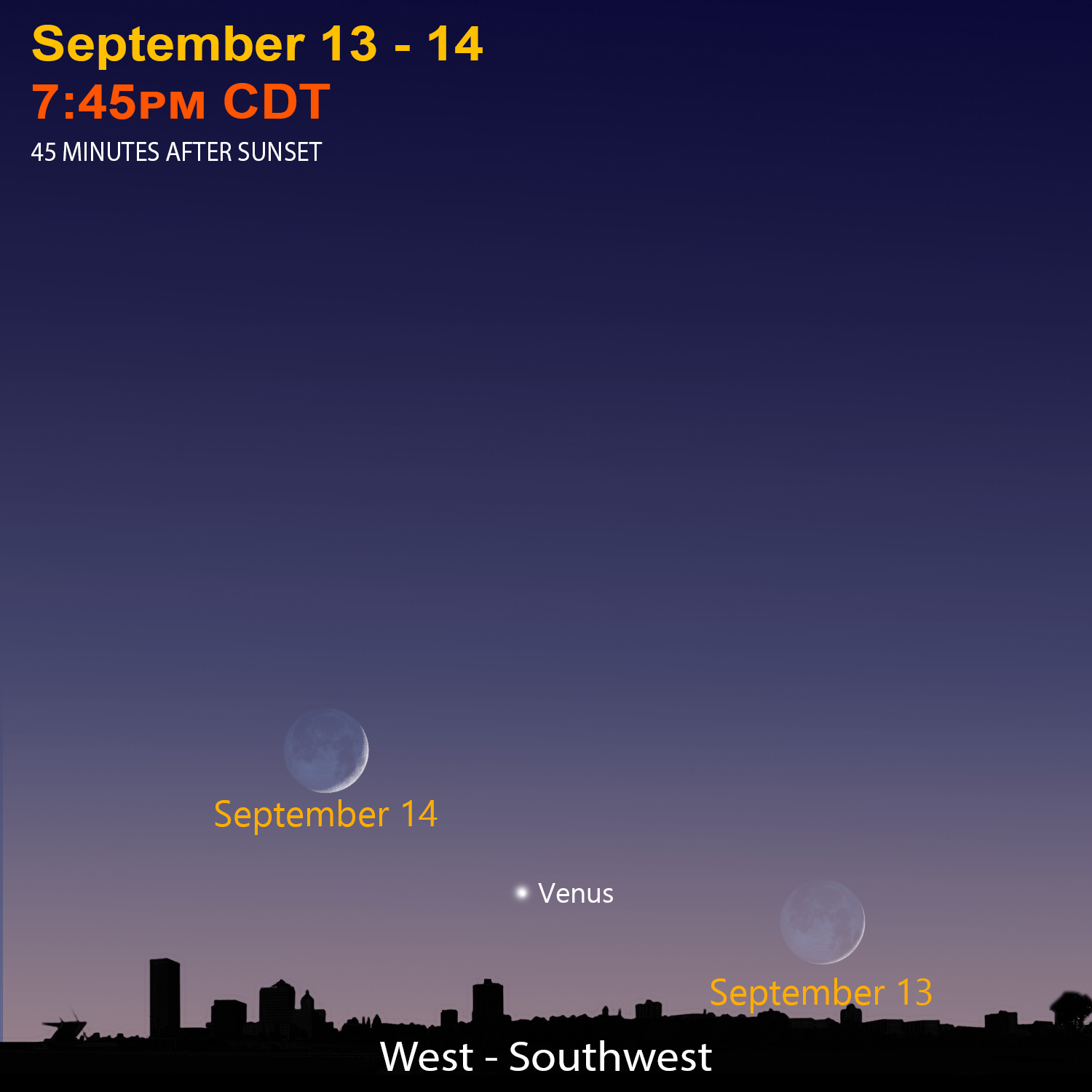
Look for a thin crescent Moon close to Venus on September 13 and 14. On October 24, the hottest planet is at inferior conjunction when Venus passes between Earth and the Sun, moving from the evening sky into the morning sky.
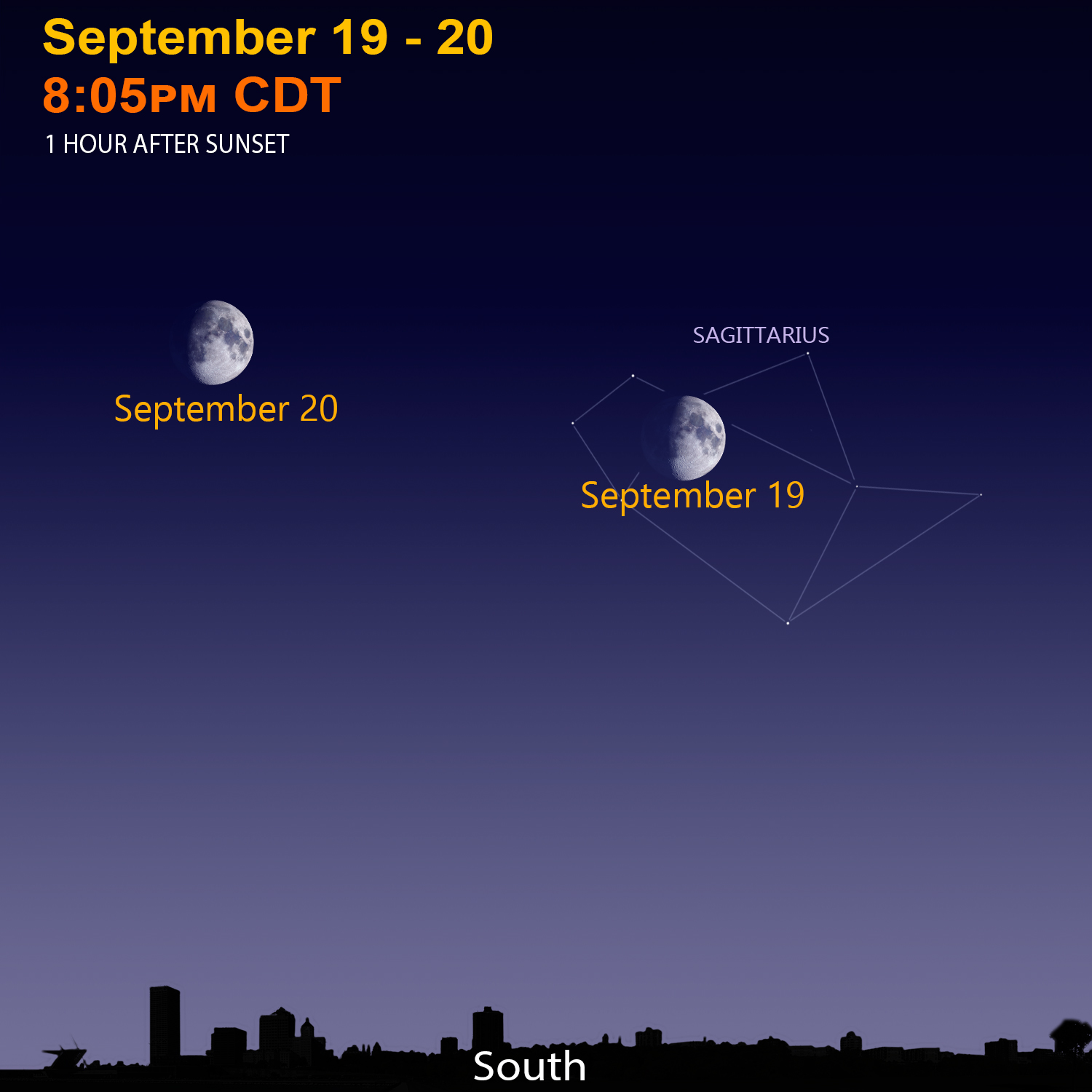
From September 19 to 20, a waxing gibbous Moon moves through the constellation Sagittarius the Archer. The nickname for this group of stars is the teapot.
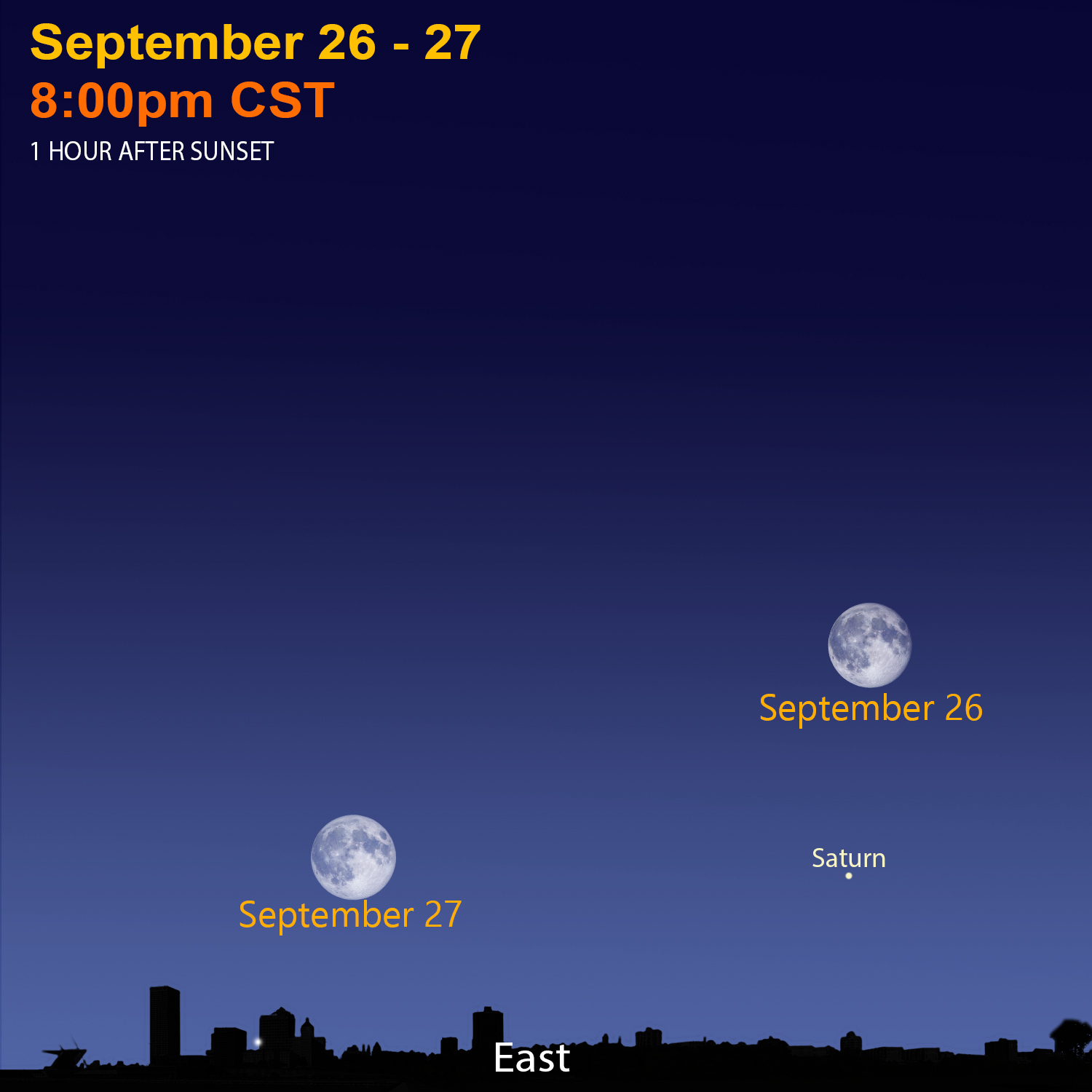
Saturn is now easy to see in the evening sky. Look for the ring jewel with a bright full Moon on September 26 and 27.
September Star Map
Sign Up
Receive this newsletter via email!
Subscribe
See the Universe through a telescope
Join one of the Milwaukee-area astronomy clubs and spot craters on the Moon, the rings of Saturn, the moons of Jupiter, and much more.
Follow Bob on social media
Twitter: @MPMPlanetarium
Facebook: Daniel M. Soref Planetarium